
How Long Until I Can Run Again After ACL Reconstruction?
“When can I start running again?” is one of the questions we get asked earliest and most often after ACL reconstruction — often well before the knee is actually ready for an answer. It’s an understandable question, since running tends to feel like the first real marker of getting back to normal. But the honest answer isn’t a date on a calendar — it’s a set of criteria your knee needs to meet first, and how long that takes varies more than most people expect.
Why there’s no single timeframe
You’ll see “3 months” quoted in plenty of places online, and for some people that’s roughly right. But return to running after ACL reconstruction is better thought of as criteria-based than time-based — it depends on how your quad and hamstring strength has recovered, how well your knee controls single-leg load, and how your rehab has progressed relative to your specific graft and surgery, not just how many weeks have passed since the operation. Two people at the same point on the calendar can be in very different places physically, which is exactly why a program built around testing tends to work better than one built around a fixed date.
What actually needs to happen first
Before running is reintroduced, a few things generally need to be in place:
- Full range of motion and no swelling — the basics of early rehab need to be settled before adding running-specific load
- A meaningful base of quad and hamstring strength — strength deficits after ACL reconstruction are common and significant, and running without addressing them tends to just reinforce poor movement patterns
- Good single-leg control — the ability to control the knee under single-leg load (think single-leg squats and step-downs) without it collapsing inward or feeling unstable
- Objective strength testing, not just how the knee feels — this is where it matters most, since confidence and how a knee “feels” don’t always line up with what it can actually handle
We use VALD ForceDecks and the VALD Dynamo to measure quad and hamstring strength and compare the injured leg against the uninjured one — a limb symmetry index. There’s no universally agreed single number, but strength sitting reasonably close to the uninjured leg, alongside good single-leg control, is generally what’s being looked for before running starts, rather than clearing everyone at an identical percentage regardless of how they’re actually moving.
What the reintroduction actually looks like
Running isn’t reintroduced all at once. It typically starts with a walk-jog progression — short bouts of straight-line jogging interspersed with walking, on a flat, predictable surface — before building up continuous distance, then pace, and only later direction changes and sport-specific movement. Rushing this sequence, particularly jumping straight to faster running or any change of direction, is one of the more common ways people set their rehab back.
What we look at in assessment
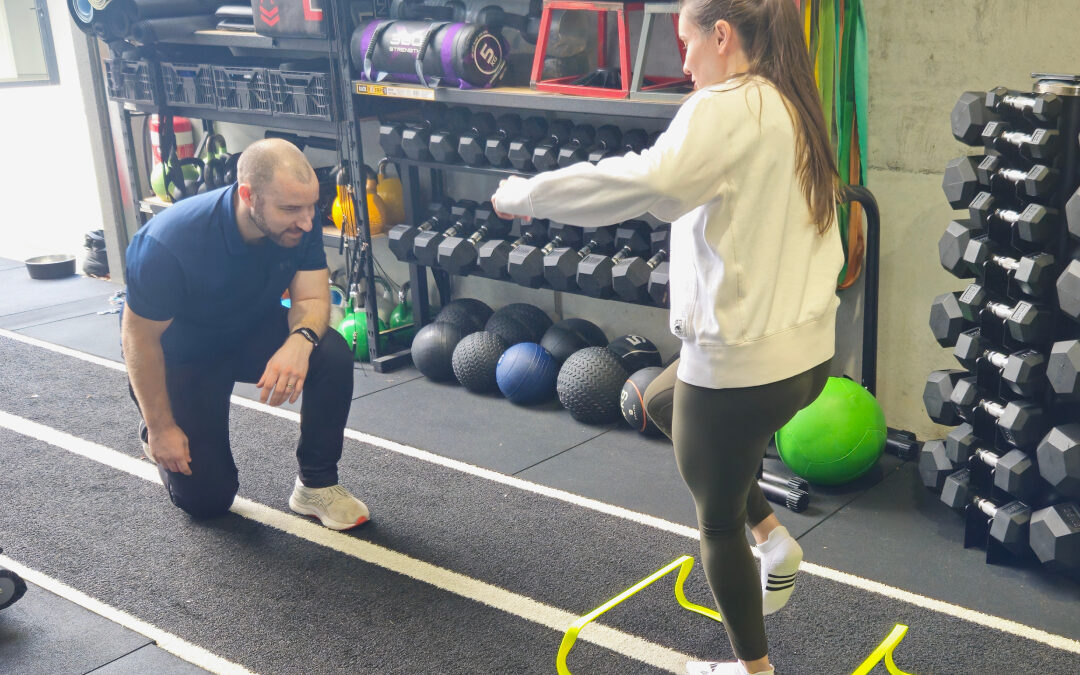
Deciding whether someone’s ready to start running isn’t based on a single test in isolation. We look at quad and hamstring strength on both sides using VALD ForceDecks and the VALD Dynamo, assess single-leg control through movements like step-downs and single-leg squats, and check in on how rehab has progressed relative to where you are post-surgery. That combination gives a clearer picture than any one measure alone — someone can have reasonable strength numbers but still show poor control under single-leg load, or vice versa, and both matter for running specifically.
Why rushing it carries real risk
Returning to running — and particularly to sport — before the knee has genuinely met these criteria is associated with a meaningfully higher risk of re-injury, both to the reconstructed ACL and to the other knee. This isn’t about being overly cautious for its own sake; it’s that the structures protecting the knee during higher-speed, higher-load movement are exactly what a rehab program is still building in the early-to-mid stages. A knee that “feels fine” walking and doing gym-based exercises isn’t necessarily ready for the demands of running, let alone cutting and pivoting.
So what’s a realistic timeframe?
As a broad guide, straight-line running typically starts somewhere in the 3-4 month range post-surgery for people progressing well, with full return to unrestricted, pivoting sport generally sitting at a minimum of nine months, and increasingly 12 months for higher-risk sports — but these are population-level figures, not a promise about any individual’s timeline. Some people meet strength and control criteria sooner; others need longer, particularly if early rehab was slower to get going or there were setbacks along the way. The honest answer to “how long” is genuinely “it depends on your knee,” which is exactly why testing matters more than counting weeks.
Our approach at Adapt Sports Physiotherapy
Our ACL rehabilitation programs use objective strength and movement testing at key milestones to guide when running — and later, sport — is reintroduced, rather than clearing people on a generic timeline. That means the running progression is built around where your knee actually is, with clear benchmarks to work toward rather than guesswork.
If you’re earlier in your recovery and want the fuller picture of what ACL rehab involves from start to finish, our ACL rehabilitation guide covers all the phases in detail. If you’re dealing with clicking or clunking as you progress through rehab, our guide to knee clicking after ACL reconstruction covers that common question, and if you’re still weighing up surgical versus non-surgical management, our guide to avoiding ACL surgery covers that decision. We work with ACL rehab patients from Chirnside Park, Ringwood, Croydon, Mooroolbark and Lilydale, and every running progression is built around your own testing results.
Frequently asked questions
- Can I just try a light jog and see how it feels? It’s understandable to want to test it out, but “how it feels” isn’t a reliable guide this early — a knee can feel fine under light load while still lacking the strength or control needed for running safely. Getting assessed first is a better approach than self-testing.
- What if my surgeon or physio gave me a different timeframe than what I’ve read online? Follow theirs. They’re working from your actual strength testing, surgery details and progress, not a general population average — individual guidance should always take priority over a generic timeline.
- Does the type of graft used affect the timeline? It can. Different graft types have different healing considerations in the early stages, which is part of why your specific surgical details matter when planning your rehab progression, rather than applying a one-size-fits-all timeline.
- I’m well past 9 months and still don’t feel ready to run — is that unusual? Not necessarily. Recovery pace varies, and if strength or confidence hasn’t caught up yet, that’s worth addressing directly through assessment and a tailored program rather than assuming something’s gone wrong.