
Why Does My Knee Click Going Downstairs After ACL Reconstruction?
You’re a few months into ACL rehab, things are progressing, and then you notice it — a click, a clunk, sometimes a catch, right as you step down a flight of stairs. It’s one of the most common questions we hear from athletes partway through recovery, and for most people it’s a normal part of the knee reloading rather than a sign that something’s gone wrong. That said, “usually normal” isn’t the same as “always fine,” so it’s worth understanding what’s actually driving it and what would make it worth a closer look.
Why clicking happens on stairs after ACL reconstruction
Going downstairs loads the knee in a way few other everyday movements do — the kneecap has to track smoothly against the thigh bone while absorbing your body weight through a bent knee, one step at a time. A few things commonly contribute to clicking in this position during ACL rehab:
- Patellofemoral tracking changes — after surgery, quad strength and control typically lag behind the rest of the leg for a period, which can change how the kneecap tracks through its groove and produce a clicking or grinding sensation.
- Quad inhibition — it’s common for the quadriceps to switch on less efficiently after knee surgery, even once strength testing shows good numbers. That altered control changes movement mechanics, particularly on stairs.
- Scar tissue and swelling changes — as post-surgical swelling settles and soft tissue remodels around the graft site, the sensation and sound of the knee moving can change for a period.
- General deconditioning — moving less than usual, or moving differently to protect the knee, changes how load moves through the joint and can bring on clicking that wasn’t there before surgery.
In most of these cases, the clicking itself isn’t damaging anything — it’s a byproduct of the knee still building back the strength and control it needs for a demanding movement like stairs. It’s also a big part of why ACL rehab progresses in stages rather than jumping straight to full training: a movement this demanding on the patellofemoral joint needs a base of strength and control underneath it first, and clicking is often simply a sign that base is still being built.
Why stairs in particular?
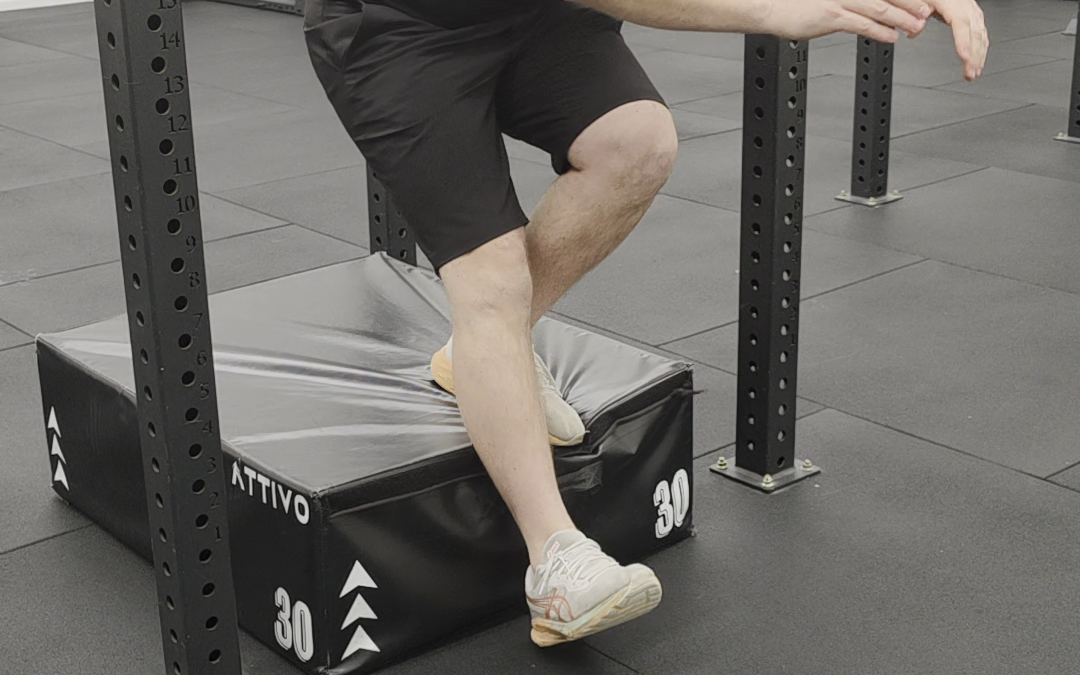
It’s not a coincidence this shows up on stairs specifically, rather than flat ground. Descending a step requires the quadriceps to control the knee eccentrically — lengthening under load rather than shortening — while taking your full body weight through a bent knee. That’s a considerably higher demand on the patellofemoral joint than walking, and it’s one of the first places a lingering strength or control deficit tends to show up during recovery. It’s also why step-downs and single-leg control work feature so heavily in the later stages of a structured ACL program — they’re training the exact movement pattern that’s giving you trouble.
Normal recovery vs. something worth checking
The distinction that actually matters isn’t “does it click” — it’s what else comes with it. Clicking on its own, without pain, is common and usually not a concern. It’s worth getting assessed if the clicking comes with:
- Pain at the time of the click, rather than just noise or sensation
- Swelling that builds after activity
- A feeling of the knee catching, locking, or giving way
- Clicking that’s new, worsening, or accompanied by a change in how the knee feels day to day
- Any doubt about whether it’s safe to keep progressing your rehab program as planned
If any of those apply, it’s worth bringing up with your physiotherapist rather than waiting to see — particularly during ACL rehab, where the plan is usually being adjusted stage by stage anyway.
What actually helps
For the common, painless version of this — clicking driven by patellofemoral tracking and quad control rather than a structural issue — the things that help are the same things already central to good ACL rehab:
- Progressive quad, hip and glute strengthening — building the strength and control that governs how the kneecap tracks under load
- Retraining the movement pattern — working specifically on the mechanics of descending stairs and step-downs, not just building strength in isolation
- Objective strength testing — we use VALD ForceDecks and the VALD Dynamo at key rehab milestones, so we can see clearly whether a strength deficit is contributing rather than guessing from how the knee feels
- Staying on the rehab timeline — clicking on its own usually isn’t a reason to pull back from your program; it’s more often a sign the knee still has strength and control to build, which the program is already addressing
There’s no fixed timeline for when clicking like this resolves — it depends on where you are in your rehab, how much quad and hip strength you’re rebuilding, and how much load you’re putting through stairs and similar movements week to week. For many people it settles gradually as strength and control catch up over the middle stages of rehab. For others it persists in a mild, painless form well past return to sport, without ever becoming a functional problem. What matters more than the timeline is whether it’s trending in the right direction as your program progresses — which is exactly what regular strength testing is there to show.
What we look at in assessment
When an ACL rehab patient comes in with this exact question, the assessment isn’t just about the knee itself. We look at where you actually sit in your rehab timeline, test quad and hamstring strength on both sides using VALD ForceDecks and the VALD Dynamo, and watch how you move through a step-down or single-leg squat rather than relying on how the knee feels alone. That combination usually makes it clear whether the clicking is a straightforward strength and control issue — the most common finding — or whether something else needs a closer look. Because the testing is objective, it also gives a clear before-and-after picture as your program progresses, rather than having to guess whether things are actually improving.
Our approach at Adapt Sports Physiotherapy
If you’re partway through ACL rehabilitation and dealing with clicking on stairs, we look at the full picture — where you are in your recovery timeline, your current strength profile, and how the knee is moving — rather than treating the click as an isolated problem. From there we adjust your program to address what’s actually driving it, whether that’s a specific strength deficit or a movement pattern that needs retraining.
If you’re earlier in your ACL journey and weighing up surgical versus non-surgical management, our guide to non-surgical ACL rehab covers that decision in more detail, and our ACL rehabilitation guide covers the full recovery process from early days through to return to sport. We work with ACL rehab patients from Chirnside Park, Ringwood, Croydon, Mooroolbark and Lilydale, and every plan is built around where you actually are in your recovery rather than a generic timeline.
Frequently asked questions
- Is knee clicking after ACL surgery always a problem? No. Painless clicking or clunking, especially on stairs or squatting, is common as the knee reloads through rehab. It becomes worth assessing when it’s accompanied by pain, swelling, catching, or a feeling of giving way.
- How long does clicking last after ACL reconstruction? It varies. For many people it settles as quad strength and control improve over the months of rehab. For some it persists in a mild, painless form well after return to sport without being a functional issue.
- Can strength training fix a clicking knee? Often, yes. Clicking related to patellofemoral tracking usually improves as quad, hip and glute strength develops and movement patterns normalise through structured rehab.
- Does clicking mean my graft has failed? Not on its own. Graft-related concerns present differently — usually with instability, giving way, or a specific incident — rather than painless clicking alone. A clinical assessment can clarify what’s actually going on.