
Can I Avoid ACL Surgery? What Non-Surgical Management Actually Looks Like
Do I actually need surgery?” is one of the first questions almost everyone asks after tearing their ACL — and the honest answer is: not necessarily. Research over the past decade has consistently shown that for the right person, a structured non-surgical program can produce outcomes comparable to reconstruction. What that program actually involves week to week, though, tends to get skipped over in favour of the surgery-or-not decision itself. Here’s what it actually looks like in practice.
Why surgery isn’t automatic
Historically, an ACL tear meant a fairly reflexive referral for reconstruction. That’s shifted. Trials comparing early surgery with a “rehab first, decide later” approach have found similar outcomes at two and five years, with a meaningful proportion of the delayed-surgery group never needing an operation at all. That doesn’t mean surgery is unnecessary for everyone — it means the decision deserves a proper look rather than an automatic referral, and that look is based on how the knee actually functions, not the scan alone.
What non-surgical ACL management is actually trying to do
For a long time, physios were taught that a fully torn ACL simply couldn’t heal itself — so the whole point of non-surgical management was building strength and control around the knee, not fixing the ligament. That’s starting to look like only part of the story. Newer research is showing that some ACLs do show real signs of healing on their own, visible on scans taken a few months after injury — and people whose scans show this tend to report their knee feeling and working better down the track. There’s also growing interest in approaches that may support this healing directly, such as bracing the knee in a particular position for several weeks early on, with promising early results.
Worth being clear about what’s actually “new” here. Non-surgical management isn’t an unproven alternative waiting to catch up to surgery — the trials comparing the two pathways already show comparable outcomes, which is well established. What’s newer and still developing is specifically the finding that the ligament itself can show structural healing on scans — that research is based on relatively small groups so far, and isn’t yet settled, mainstream practice. It doesn’t mean every ACL will heal, or that bracing alone replaces a proper, supervised program. What it does mean is that “the ACL just can’t heal” isn’t the full picture anymore — another point in favour of non-surgical management being a genuinely reasonable option to explore, not just a fallback for people who can’t have surgery. Either way, the core of the approach is the same: building enough strength, control and movement quality around the knee that it functions well, whether or not the ligament itself ends up healing.
There’s also a more straightforward reason non-surgical management is worth considering: it avoids surgery altogether, graft and all. ACL reconstruction uses a graft, usually taken from your own hamstring or patellar tendon, and that donor site has its own recovery to go through — pain, weakness and sometimes lingering sensation changes around where it was taken from, on top of rehabbing the knee itself. Non-surgical management sidesteps that entirely, along with the general risks that come with any operation and anaesthetic. That’s not a reason to rule surgery out if it’s the right call for you — but it’s a genuine factor worth weighing up either way.
What a non-surgical program actually involves
This is usually the part that gets glossed over. In practice, it’s a structured, staged program rather than a loose instruction to “strengthen it up”:
- Early-stage work — settling swelling, restoring full knee extension, and getting the quadriceps reactivating properly, since quad activation is often one of the first things affected after an ACL injury
- Progressive strengthening — building quad, hamstring and glute strength in a structured, staged way rather than jumping straight to heavy loading
- Balance and control work — retraining the knee’s ability to control itself under single-leg load, which matters more for stability than most people expect
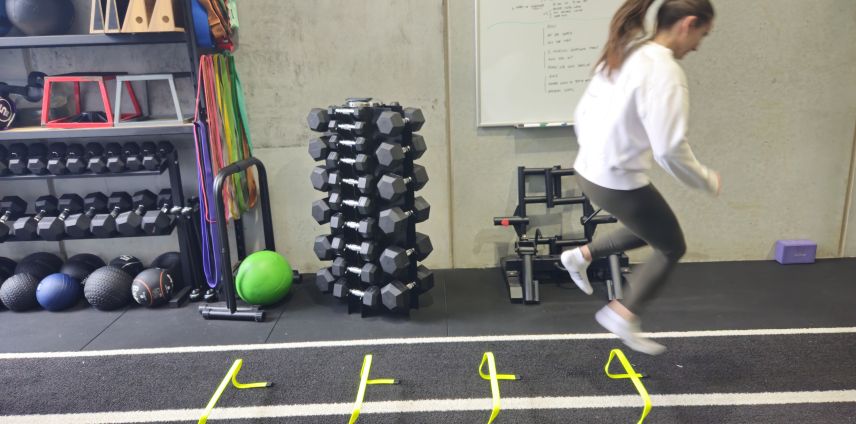
- Functional and sport-specific training — gradually reintroducing change-of-direction and impact-based movement once the strength base is there to support it
- Objective testing before progressing stages — checking strength and control against benchmarks before moving to more demanding loads, rather than progressing on a fixed timeline alone
It’s a genuine program, not a shortcut — the overall timeline for returning to high-level pivoting sport sits in a similar range to surgical recovery, generally in the order of 9-12 months, and it asks for the same consistency and commitment a post-surgical rehab would. Early on, that typically means fairly regular sessions while the basics of swelling control and quad activation are being re-established, tapering to a program you’re largely running yourself between check-ins as strength and control build through the middle stages. The commitment isn’t smaller than a surgical pathway — it’s just directed differently, since there’s no operation setting a hard reset on where the knee’s starting from.
Who tends to be a reasonable candidate
Non-surgical management is worth genuinely exploring for some people, and less suited to others. Factors that tend to make it a more reasonable path include:
- Minimal knee instability, without repeated giving-way episodes
- Not currently playing high-demand pivoting sport such as football, netball or basketball
- No significant associated damage, such as a meniscus tear, that would change the picture
- Willingness to commit to a thorough, staged rehabilitation program rather than a partial one
None of these on their own settle the question — they’re part of a bigger picture that a proper assessment puts together, including how the knee actually performs under load rather than just how it feels.
How progress is actually tracked
Because there’s no surgery marking a clear “before and after,” tracking progress objectively matters more in non-surgical management, not less. We use VALD ForceDecks and the VALD Dynamo to measure quad and hamstring strength at key points through the program, rather than relying on how the knee feels or how much time has passed. Comparing the injured and uninjured leg gives a limb symmetry index that helps indicate whether the knee is actually ready to progress to the next stage, or whether there’s a specific gap still worth addressing first. Hop testing and movement-quality assessment play a similar role further along, particularly before any return to pivoting sport — the aim throughout is to base each decision to progress on what the data actually shows, rather than how far along the calendar says you should be.
What if it doesn’t end up being enough?
Choosing to start with non-surgical management doesn’t close the door on surgery later. If a thorough program doesn’t resolve functional instability, reconstruction remains an option — and going into that surgery with a stronger, better-conditioned knee is generally associated with a smoother recovery afterward. Starting with rehab, whichever way the decision eventually goes, is rarely time wasted.
Our approach at Adapt Sports Physiotherapy
If you’re weighing up surgical versus non-surgical management after an ACL injury, our ACL rehabilitation programs are built around your actual knee function and goals — not a reflex referral in either direction. We’ll give you a clear picture of where things stand and what each path would realistically involve, so the decision is an informed one.
If you’re specifically in Ringwood and want more detail on the decision itself, our guide to non-surgical ACL rehab for Ringwood athletes covers that in depth. And if you’re further along and dealing with knee clicking during rehab, our guide to knee clicking after ACL reconstruction covers that common question. We work with ACL rehab patients from Chirnside Park, Ringwood, Croydon, Mooroolbark and Lilydale, and every plan is built around your specific knee rather than a generic protocol.
Frequently asked questions
- Does skipping surgery mean the ACL heals back together? Sometimes, to a degree — this is an evolving area. Newer research has found real signs of ACL healing on scans in a good number of people managed without surgery, especially when picked up early. It’s not guaranteed and the research is still developing, but non-surgical management works either way — by building strength and control around the knee — whether or not the ligament itself ends up healing.
- Is non-surgical management just a slower version of the same recovery? Not quite — the overall timeline is actually similar to surgical recovery for a full return to high-level sport, generally around 9-12 months either way. It’s a different pathway, not a shortcut or a delay.
- Can I decide partway through that I want surgery after all? Yes. Starting with rehab doesn’t rule out surgery later, and going in with a stronger, better-conditioned knee is generally associated with a smoother surgical recovery if that’s the path you end up choosing.
- Is this suitable for younger athletes or children? This is an area that needs careful, individual consideration, usually involving both a physiotherapist and an orthopaedic surgeon, since skeletal maturity is part of the decision. It isn’t a simple yes or no.