
Return-to-Sport Testing After ACL: What It Actually Involves
“When can I get back to playing?” is usually one of the first questions after an ACL injury, and by the later stages of rehab it becomes the main one. The answer isn’t a date circled on the calendar — it’s a set of tests your knee needs to pass first. Return-to-sport testing is how that gets decided properly, rather than guessed at, and it’s worth understanding what it actually involves before you get there.
Why testing matters more than time
Nine months, twelve months — you’ll see timeframes quoted everywhere, and they’re useful as a rough guide. But time alone doesn’t tell you whether a knee can actually handle the demands of sport again. Two people at the same point post-surgery can be in genuinely different places physically, and returning based on the calendar rather than on how the knee is actually performing is one of the clearer drivers of re-injury. Testing exists to answer the question time can’t: is this specific knee, right now, actually ready for this specific sport?
The strength side of testing
Strength symmetry between the injured and uninjured leg is one of the foundational pieces. At Adapt Sports Physiotherapy, we use VALD ForceDecks and the VALD Dynamo to measure quad and hamstring strength objectively, rather than relying on how the leg feels. A commonly used benchmark in return-to-sport decisions is around 90% limb symmetry across key muscle groups — meaning the injured leg is producing close to the same force as the uninjured one — though this is one data point among several, not a single pass/fail line applied in isolation.
Hop testing
Hop tests are a core part of most return-to-sport batteries because they test power, control and confidence under load in a way strength testing alone doesn’t. A typical battery includes a combination of:
- Single hop for distance — a single maximal hop, measuring distance and comparing injured versus uninjured side
- Triple hop for distance — three consecutive hops, adding a repeated-load and coordination element
- Crossover hop for distance — hopping diagonally across a line, adding a change-of-direction and control component
- Timed hop — hopping a set distance as quickly as possible, testing speed alongside control
As with strength, the comparison that matters is between your injured and uninjured leg — a limb symmetry index around 90% or higher across these hop tests is a commonly used benchmark, alongside watching how the landing and control actually look, not just the distance or time achieved.
Movement quality and control
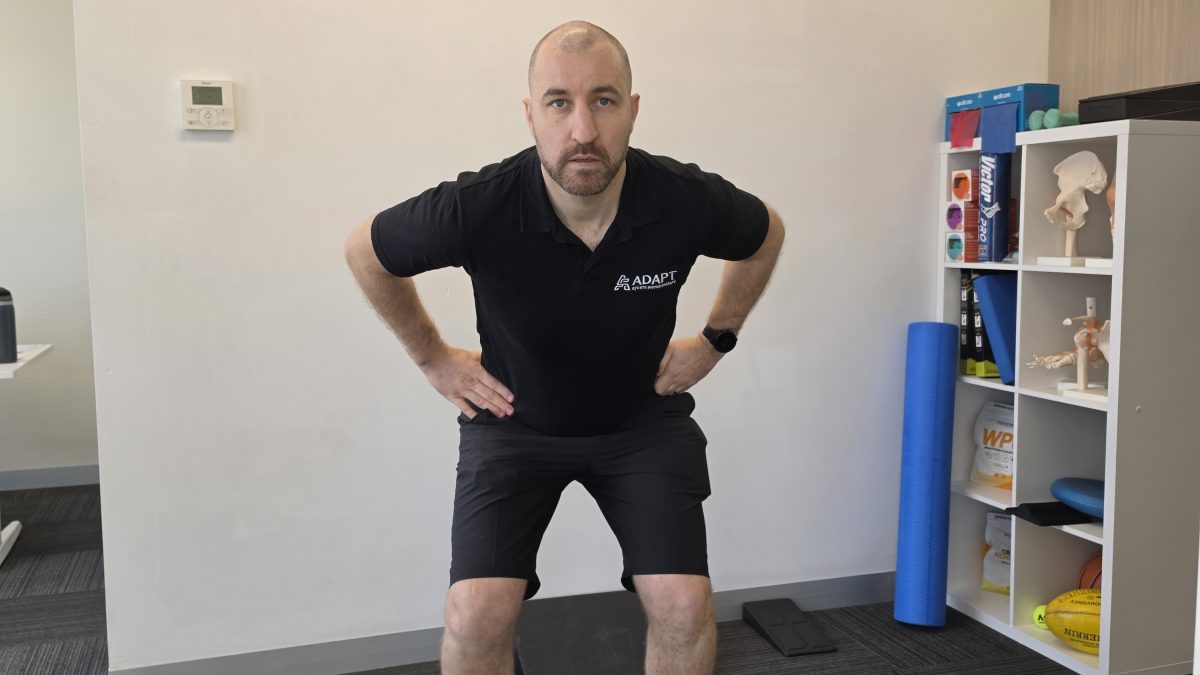
Numbers alone don’t tell the full story. How the knee moves under load — whether it collapses inward on landing, how controlled the deceleration is, whether one side compensates for the other — matters alongside the raw strength and hop distance figures. Two people can hit similar numeric benchmarks while moving very differently, and movement quality is often where a genuine gap gets picked up that pure numbers would miss.
Psychological readiness
This part gets talked about less, but it’s a genuine factor. Confidence in the knee — not being hesitant, not unconsciously favouring the uninjured leg, not holding back out of fear of re-injury — affects both performance and actual injury risk, since hesitation changes movement patterns in ways that can make re-injury more likely, not less. It’s a normal part of the picture to discuss openly rather than something to push through silently, and it’s increasingly recognised as part of what a thorough return-to-sport assessment should touch on, alongside the physical criteria.
Context still matters too
Testing gives an objective picture of where the knee is at, but the decision of when to actually return still involves some individual context — how early or late in the season it is, what’s coming up, and how much risk you’re comfortable carrying into a given game or event. A knee that’s cleared on testing in February carries a different conversation to one cleared the week of a grand final with no more games left that season. This is worth an honest conversation with your physio rather than a decision made alone, since understanding the re-injury risk picture helps inform it either way.
What we look at in assessment
A return-to-sport assessment at this stage typically brings several pieces together: strength testing via VALD ForceDecks and the VALD Dynamo, a hop test battery with both distance/time and landing quality assessed, and a conversation about confidence and any hesitation around the knee. Bringing these together gives a genuinely objective picture, rather than clearing someone because enough time has passed or because the knee “feels fine” in isolation — both of which can be misleading on their own.
Our approach at Adapt Sports Physiotherapy
Our ACL rehabilitation programs use objective testing to guide return-to-sport decisions rather than clearing people on a generic timeline. That means working through the full picture — strength, hop performance, movement quality and confidence — before signing off on a return to your sport.
If you’re earlier in your recovery and specifically focused on getting back to running first, our guide to running again after ACL reconstruction covers that earlier milestone in detail, and our ACL rehabilitation guide covers the full recovery journey from early days through to this stage. We work with ACL rehab patients from Chirnside Park, Ringwood, Croydon, Mooroolbark and Lilydale, and every return-to-sport decision is built around your own testing results.
Frequently asked questions
- Do I need to pass every single test to return? Not necessarily in a strict pass/fail sense — testing builds an overall picture, and the results are discussed together rather than any one number being an automatic go/no-go on its own. That said, a clear gap in any area is worth addressing before returning, not working around.
- What if I’m well past 9-12 months and still haven’t passed testing? That happens, and it’s worth addressing directly rather than assuming something’s permanently wrong. Recovery pace and starting points vary, and ongoing gaps in strength or confidence are generally still addressable with the right focus.
- Is hop testing safe if I’m still nervous about my knee? It’s introduced progressively as part of rehab, not sprung on you at the final stage — by the time formal return-to-sport testing happens, you should already have plenty of experience with loaded, single-leg movement from earlier in your program.
- Can I test myself at home instead of coming in? Meaningful comparison needs consistent setup and someone assessing landing quality and technique, not just a distance measurement — a DIY version at home is unlikely to give a reliable picture either way.